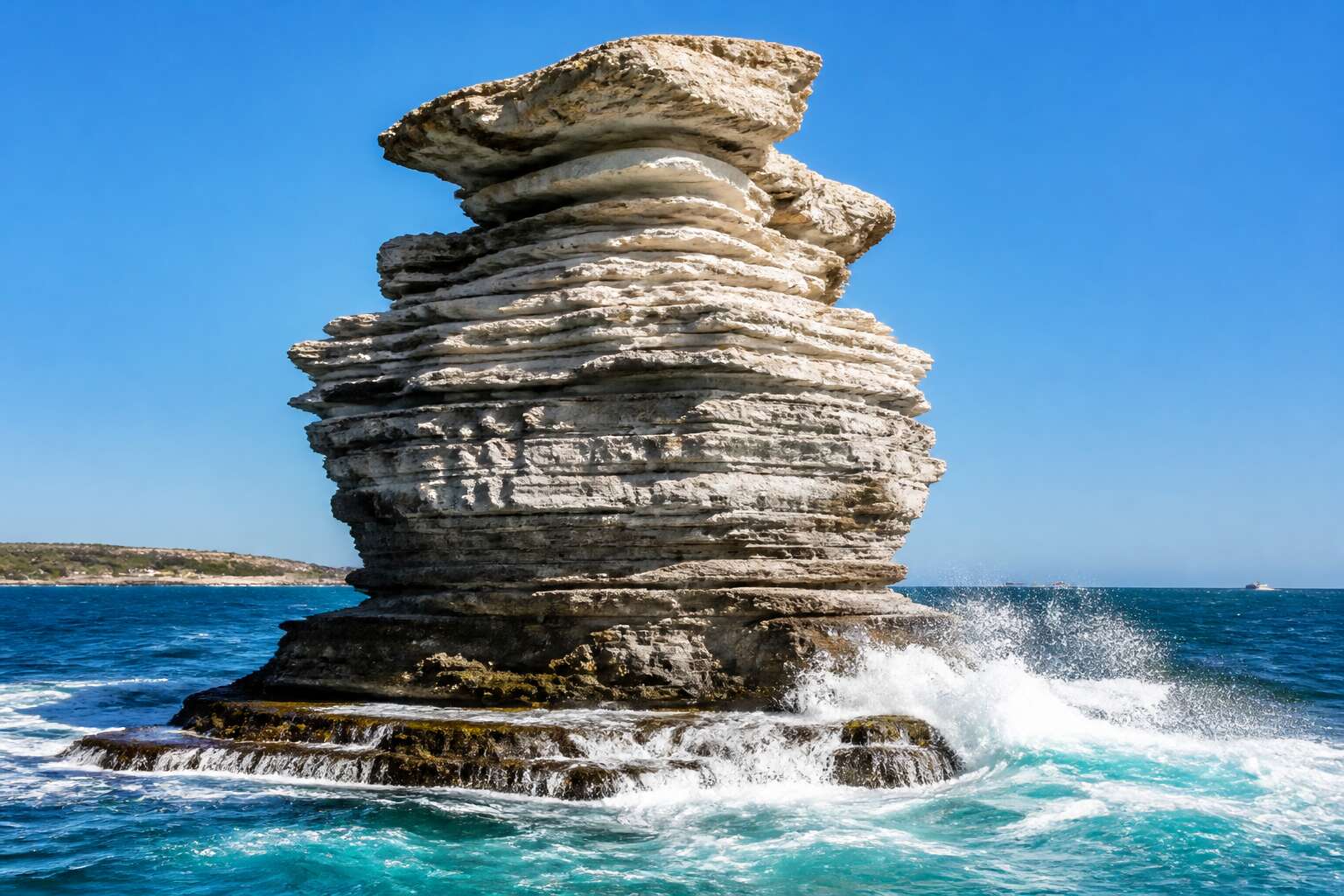
The Iconic Landmark
Location and Setting
The sandstone layers within the wedding cake rock sydney formed over 200 million years ago. Thousands of walkers reach this headland each year, yet most only glimpse the formation from the cliff top. The pale stone rises 30 metres above the water, carved into stepped ledges by wind and salt.
The setting gives the landmark its character. The rock rests inside a protected reserve, with walking tracks threading through coastal banksia and heath. Several vantage points exist:
- The northern platform offers the classic profile against the open ocean
- The eastern ledge looks straight down onto the wave-cut notch at the base
- The southern track exposes fissures worn by centuries of storms
The ocean refuses to stay calm for long. The swell can double in size within an hour! The water shifts from green to indigo as clouds pass overhead. The wedding cake rock sydney remains constant, drawing photographers and locals to this quiet stretch of coastline.
Why It Captures Global Attention
Roughly 10,000 photographs of wedding cake rock sydney are posted online each month, yet the formation remains indifferent to its fame. That indifference is precisely what captivates. The rock sits on the edge of the Pacific, pale and brittle, a chalk-white anomaly against the heaving water. Walkers who descend to the viewing platforms describe the same sensation; a strange quiet, a stillness that feels older than the city itself!
Why does this formation command such global attention?
- The white crust, caused by iron oxide, makes it look like nothing else on the Australian coastline.
- The constant threat of collapse lends every visit an edge of unease.
- The contrast between the manicured reserve and the raw, eroding stone creates a tension that cameras try and fail to capture.
The landmark has become a fixture of the online world. Wedding cake rock sydney has been photographed to the point of saturation, and it still keeps its secrets.
Cultural and Historical Significance
Culturally, the landmark has layers. Stone and story have accumulated over decades. It earned its nickname long ago, when someone decided the pale tiers looked like a wedding cake. No actual cake has ever sat on the rock, but the name stuck, which is remarkable given how often Sydney renames its corners.
The Bidjigal people know the coastline through older names and narratives. Yet wedding cake rock sydney belongs to no one in particular. It has hosted proposals, picnic disasters, and at least one drone casualty.
Its historical significance lies in survival:
- Erosion has claimed metres of the surrounding cliffs.
- Tourist fences have gone up and come down.
- Climate debates have raged over sea levels.
Wedding cake rock sydney remains, indifferent to it all.
Geological History and Formation
Ancient Rock Layers and Composition
Two hundred million years ago, this coastline was a river delta. Wedge after wedge of sand piled up, then compressed into the quartz sandstone that forms Wedding Cake Rock Sydney. The rock’s bright white face comes from iron oxide leaching out over millennia. I have never seen a white surface quite like it!
The layers reveal ancient storms and shifting currents. You can trace them in the horizontal bands, each one a record of a vanished world. A quick look at the composition reveals:
- Quartz grains, over 90 percent of the mass
- Fine clay binders that hold the stone together
- Trace minerals like hematite and limonite
That’s why the surface feels so smooth. Wedding Cake Rock Sydney is soft and prone to erosion. It’s a fragile monument, one that won’t last forever.
Volcanic Origins and Tectonic Activity
Some geologists measure the Australian continent drifting northward four centimetres each year, a relentless reminder of the forces that shaped this coastline. Long before the sand turned to stone, volcanic fissures scarred the ancient landscape during the breakup of Gondwana, while tectonic plates ground against each other beneath the sea.
That violent past tilted the sedimentary beds and pushed the quartz-rich rock upward. Basalt from deep mantle plumes injected into the crust, creating a hardened foundation beneath the softer sandstone.
- Rifting between Australia and Zealandia started around 85 million years ago
- Fault lines control the orientation of the cliff faces
- Later volcanic activity formed the nearby diatremes and dykes
Without that tectonic buckling, wedding cake rock sydney would remain buried under kilometres of younger sediment. The same forces still nudge the coast, and the slow dance continues beneath your feet.
Erosion and Weathering Over Millennia
The same tectonic forces raised this monolith and then condemned it. Wedding cake rock sydney now withstands sea spray, windborne sand, and the daily cycle of wetting and drying. Each tide pushes salt into microscopic cracks; crystallising salt exerts pressure that pries apart quartz grains.
Softer sandstone erodes faster than the silica-cemented bands. Differential weathering sculpts the tiered silhouette, a fluted tower changing with each storm. The rock is not static; it is a snapshot of process.
Consider the timeline:
- Acidic rainwater dissolves the natural cement.
- Gales hurl sand against the lower face.
- Lichen and algae weaken the surface.
Each crack widens, each ledge hollows. Visiting this formation means confronting deep time; no force on earth can pause the slow return to sand!
Unique Features of the Rock Structure
Few geological landmarks reveal their ancestry as plainly as wedding cake rock sydney. The formation began as horizontal sand layers deposited in the Triassic period. Tectonic uplift later rotated the entire sequence to a near vertical stance. Stand before it and you see a cross section of ancient river deltas, compacted and cemented into sandstone.
The unique structure emerges from these vertical strata. Harder, silica rich bands project outward while softer sections recede, carving the stacked profile that gives the landmark its name. Each tier marks a shift in deposition conditions, a change in grain size or mineral content from a time when this landscape sat far inland.
- Vertical joint sets that fracture cleanly along pre existing weaknesses.
- Thin iron oxide crusts that harden outer surfaces and darken the rock.
- Pitting and honeycomb weathering on the lower flanks, driven by salt spray.
The rock is a record of slow construction followed by slow removal. Returning to wedding cake rock sydney across different years reveals a slightly altered monument, but the layers remain legible.
Hiking and Access
Getting to the Base
The route to Wedding Cake Rock Sydney begins at the Bundeena wharf. Follow the coastal track toward Jibbon Head. It is roughly three hours return. The path climbs over sandstone ledges and dips into patches of banksia woodland. You will not approach the rock directly; the final stretch loops behind it, with the white strata appearing first from above.
Bring water, a hat, and shoes with proper grip. The surface can be slick after rain. If you are not used to exposed heights, stay well back from the edge. For a safer walk, remember:
- Check tide times before setting out
- Keep to the marked trail at all times
- Pack out all rubbish, including fruit peels
The approach is not technical, but preparation matters.
Trail Difficulty and Fitness Requirements
The hike to wedding cake rock sydney is achievable for most active travellers. The track from Bundeena follows the coastal cliffs, gaining elevation gradually. You’ll scramble over a few boulders and navigate sandy patches. For the average person with reasonable stamina, the three hour return trip feels challenging yet manageable.
- A good pair of hiking shoes with grip is non-negotiable.
- Carry at least a litre of water per person.
- Pace yourself on the uphill sections.
The last stretch involves a steep descent to the viewing platform. If you have vertigo, stay back from the edge. Fitness requirements are moderate, not extreme. Regular walking a few times a week will prepare you. Start early for cooler conditions and clearer views.
Permits, Fees, and Park Regulations
The hike to wedding cake rock sydney requires no entry permit, which keeps the experience spontaneous. Access starts from Bundeena Drive, where visitors park free at the Royal National Park entrance. However, the rock itself sits behind a fence. Park authorities closed the platform in 2015 after vandals damaged the fragile sandstone. Climbing over that fence carries a fine of up to $3,300.
Regulations remain straightforward:
– Stay on marked trails
– Keep dogs on leads
– Carry out all rubbish
No fees apply for day visitors, but the park does require a pass for overnight camping. A simple self-service envelope at the car park covers that cost. Respecting the fencing protects both visitors and the fragile rock formation.
Safety Considerations and Weather Conditions
A sudden southerly buster can turn a calm morning at wedding cake rock sydney into a gusty ordeal within minutes. The exposed clifftop path offers little shelter, so checking the Bureau of Meteorology forecast before setting out is non negotiable. Summer temperatures often push past 30 degrees Celsius, and the unshaded track drains energy quickly. Carry at least a litre of water per person, even for the short approach!
- Start early to avoid the midday heat
- Wear sturdy shoes with grip for loose sandstone
- Watch for wet rock after rain, it becomes slick instantly
Winter conditions bring their own challenges. Cold fronts sweep through with little warning, and ocean spray can leave the boardwalk dangerously slippery. The parking area fills fast on clear days, so arrive before 8am to secure a spot. Remember, the fence exists for a reason, and the view from behind it remains worth the trip.
Guided Tours vs. Self-Guided Exploration
Reaching wedding cake rock sydney demands a decision: go with a guide or go solo. The track is straightforward, but the access point sits within a national park with strict entry rules. Self-guided hikers enjoy flexibility, setting their own pace along the coastline. Guided tours, however, often secure permits and provide context about the rock’s fragile geology that you would otherwise miss.
Consider your priorities before choosing:
- Self-guided: free to linger at viewpoints, but you must navigate park signage and parking fees alone.
- Guided: higher cost, yet includes transport logistics and safety briefings for the cliff edges.
For most visitors, a self-guided walk suffices, provided you check the tide times and park alerts. The path is well worn, but the reward of seeing wedding cake rock sydney up close justifies the effort either way.
Photography and Viewing Tips
Best Times of Day for Lighting
The golden ratio of light to rock appears for only a fleeting window each day. I have stood before this bleached sandstone monolith at dawn, and I can tell you that the morning glow transforms its surface into something almost luminous. The eastern sun catches the mineral streaks, revealing textures invisible by midday.
Sunrise offers the softest illumination, with long shadows carving depth into the stratified layers. By 9 a.m., the light becomes harsh and flat, washing out the delicate bands of iron oxide. Afternoon conditions shift again, and the golden hour before sunset paints the rock in warm amber tones.
– Arrive before 7 a.m. on clear summer mornings
– Schedule winter shoots between 3 p.m. and 5 p.m.
– Check cloud cover forecasts for diffused lighting effects
These windows deliver the most flattering conditions for photographing wedding cake rock sydney. The iconic white surface reflects the sky’s changing palette, so overcast days produce a soft, even exposure. Low-angle sunlight during these periods creates a natural contrast that brings the remarkable geology into sharp relief.
Top Vantage Points for Panoramic Shots
I remember standing on the southern escarpment’s edge, peering across the valley at wedding cake rock sydney. That perspective reveals how the monolith sits within the broader landscape. For panoramic shots, move beyond the base! A classic spot is the Bundeena track’s upper switchbacks, where the rock emerges above the treeline. Another useful angle comes from the water-level boardwalk along the Hacking River, capturing reflections in the still morning water. The tip of the weathered promontory offers an unobstructed western view, ideal for catching the low sun’s warmth.
Several vantage points lend themselves to varied compositions:
- The cliff lookout at the park’s northern boundary, offering a 180 degree sweep.
- The rocky shelf near the river mouth, providing foreground texture.
- The eastern beach approach, framing the rock against the ocean swells.
Each viewpoint alters the geological narrative, mitigating the risk of monotonous frames. I recommend arriving early at these spots, as other photographers also seek these prime positions. The interplay of distance and elevation turns a simple image into a layered story of rock, water, and sky.
Recommended Camera Gear and Settings
One of the most persistent challenges when photographing this landmark is managing the intense contrast between the white sandstone and the deep blue of the ocean. The rock’s surface acts as a natural reflector, often tricking your camera’s light meter into underexposing the surrounding landscape. To capture the true texture of the iron-stained strata, I usually expose for the highlights and let the shadows fall where they may. This approach preserves the delicate detail in the stone’s weathered face.
For crisp results, your shutter speed is your best ally. Even on calm days, a slight breeze introduces enough camera shake to soften the image. A lens with a focal length of around 50mm to 85mm often yields the most flattering perspective, compressing the rock against the water without introducing excessive distortion.
A few lens choices work exceptionally well here:
– A wide-angle 16-35mm for capturing the rock’s full mass from the cliff tops.
– A prime 85mm for isolating the layered texture on the southern side.
– A telephoto 135mm for compressing the monolith against the distant headlands.
Finally, patience plays a critical role in the process. The morning haze can mute the vividness of the scene, so waiting for a clear pocket of air is essential. I often find that a polarising filter makes a significant difference, cutting through the glare to reveal the banded geological formations. Remember to shield your lens from stray sunlight. A simple hood protects against flares which can wash out the whites, ensuring your final images of wedding cake rock sydney remain sharp and vibrant. For the best results, seek a clear view of the rock’s eastern face during low tide, which allows you to set up just below the main viewing platform for an alternative angle.
Nearby Attractions and Itineraries
Other Coastal Walks and Lookouts
After you pay respects to the wedding cake rock sydney, the Royal National Park offers a buffet of coastal diversions. The Coast Track stretches south to Garie Beach, where cliffs get more theatrical. Do not expect solitude on weekends! The trail attracts hikers, dogs, and the occasional influencer.
For those who prefer panoramas with less leg effort, several lookouts deliver:
- Curracurrong Falls lookout, a short detour rewarding with a waterfall crashing into the sea.
- Eagle Rock lookout, offering a different angle of the same sandstone drama.
- Wattamolla picnic area, where you can swap hiking boots for a swim.
An efficient itinerary pairs the wedding cake rock sydney with an early visit to Bundeena ferry wharf, then a ramble along the Jibbon Head loop. That route gives Aboriginal engravings and whale watching during migration season, without repeating the same rock twice.
Local Dining and Refreshment Options
The Royal National Park holds a strange mirror to the soul. After you have stood before the wedding cake rock sydney, the body craves grounding. Local dining options in Bundeena cater to that need with a quiet efficiency. The casual cafes along Brighton Street offer post-hike sustenance. One can sit with a flat white and watch the ferries cut through the water, the day’s exertion settling into the bones. The contrast is stark. The ancient geology of the park versus the transient comfort of a fresh pastry creates a peculiar psychological balance.
An efficient itinerary might pair the wedding cake rock sydney with a late breakfast. The sequence matters. Physical effort first, then reward. For a more substantial meal, the local fish and chip shop provides a practical solution. It lacks pretension, which feels correct after hours in the bush. The salt air and the vinegar on the chips share a common ancestry.
– Grab a coffee at a Bundeena café before the coastal ramble.
– Return for a counter meal at the local pub, which offers a robust menu.
– Purchase a picnic lunch from the general store to eat at Wattamolla beach.
The connection between place and palate is rarely discussed, yet it defines the experience. The ferry ride back to Cronulla offers another layer. The urban bustle returns, and the memory of the wedding cake rock sydney fades slowly, replaced by the immediacy of a cold drink at a harbourside bar. The day completes a full cycle. From the raw, silent power of the rock to the simple, human act of sharing a meal. It is the most honest way to process the wildness you have just witnessed. The food is not the main event, but it is the necessary footnote.
Combining with a Full-Day Adventure
Nobody visits the wedding cake rock sydney and leaves immediately. The surrounding coastline makes that impossible. Within a few kilometres you have Curracurrang Falls, Wattamolla beach, and the historic remains of an old mining operation. A full day itinerary simply connects these dots.
A workable sequence:
- Catch the first ferry from Cronulla to Bundeena.
- Hike the Coastal Track to the wedding cake rock sydney at low tide.
- Continue south to Curracurrang Falls for a picnic.
- Return via the inland fire trail to complete the loop.
The entire circuit takes seven hours. Carry two litres of water. The sun here does not negotiate, something South Africans understand well. The park also runs a shuttle bus for those who want to skip the return leg. You will finish tired, sunburned, and convinced the ferry ride back is too short.
Seasonal Highlights and Events
Winter offers a rare kind of silence along this coastline. Between May and November, southern right whales migrate past the cliffs, and their blows echo across the water while the wedding cake rock sydney stands watch. The low sun casts long shadows over the platforms, and the track feels almost private.
Spring brings a different energy. The heathland ignites with banksias and waratahs, and the air fills with birdsong. Local rangers run short walking tours during October, timed for the wildflower peak. For those who prefer structure, these events book out weeks ahead.
- Whale watching: May to November
- Wildflower blooms: August to October
- King tide photography: January and June
Summer demands discipline. By seven in the morning, the heat already presses down, but the reward is an empty path and a shimmering ocean. The park hosts a coastal fun run each February, routing runners past the rock before the crowds arrive.




0 Comments