The Historical Roots of Wedding Cake Traditions
Ancient Roman Origins: Breaking Bread Over the Bride
A Roman bride’s wedding cake was never sweet, and never meant to be eaten! The mustaceum, a brittle loaf of wheat and barley, served a rougher purpose. The groom broke it over her head, scattering crumbs that guests gathered as tokens of good fortune. This act grounds what the wedding cake symbolizes: fertility, abundance, and shared luck for the newlyweds.
The wheat itself carried meaning. Grain represented nourishment and rebirth, essential qualities for a marriage intended to produce heirs. The bride’s head, as the sacred center of the ceremony, received the blessing directly. The groom’s participation established a shared covenant. His gesture did more than bless; it announced a partnership where both parties contributed to the household’s future prosperity. Roman tradition thus informs the elaborate customs observed today.
Medieval English Customs: Stacked Buns and a Kiss
A tower of spiced buns stood between the medieval couple. They had to kiss over it without sending it crashing. The wedding cake symbolizes, in this moment, a test of coordination as much as affection. Guests stacked the buns high, and the crowd’s hunger made the stakes immediate. Success promised abundance. Failure whispered of discord ahead. The moment the kiss landed, guests lunged for the buns, each snatched crumb carrying a piece of the couple’s fortune.
The symbolism ran deeper than the gesture:
- The tower’s height measured the couple’s ambition.
- The kiss cemented their shared pact.
- The guests’ scramble transformed private luck into communal blessing.
What the wedding cake symbolizes here is accountability. I find that accountability striking. The performance unfolded before witnesses, making their coordination, or its absence, public knowledge. The buns were not mere refreshment. They were stakes in a shared gamble, binding the household’s prosperity to the community that cheered, judged, and devoured.
The Evolution of the White Wedding Cake
In 1850, a wedding cake cost more than a laborer earned in a year. That expense was deliberate! What the wedding cake symbolizes at its historical root is status made public. Before white confections, English couples served the bride’s pie, a mutton pastry hiding a single ring. Guests dug their fingers through the dark crust, and the finder would marry within the year. French patissiers answered with pièces montées, towering spun sugar sculptures meant for staring, never for the mouth.
The white wedding cake emerged with Queen Victoria. Royal icing, egg white and sugar, gave the cake a flawless white surface. White sugar was a luxury, so the unblemished frost announced wealth before anyone tasted a crumb. Victoria’s four foot wide 1840 cake cemented the fashion. Every pale tier since repeats that declaration. The wedding cake symbolizes purity and prosperity, though its true color was always money. I have studied enough Victorian engravings to recognize that hunger.
The Rise of the Tiered Cake and Its Royal Influence
The wedding cake symbolizes an ascent. Each tier is a step. The bride and groom climb together. The foundation is wide, the crown is narrow. That deliberate geometry arrived when pastry chefs began engineering stacked confections for royal courts. The rise of the tiered cake was theatrical before it was edible.
Royal influence set the standard. A monarch’s celebration required a centrepiece that outshone the table, so bakers built upward. The taller the cake, the deeper the guest’s sense of wonder. That wonder carried into ordinary homes.
Traditions layered onto this architecture:
- The top tier, saved for the first child’s christening.
- The middle tiers, wrapped and given to absent guests.
- The bottom tier, cut by the couple as their first shared duty.
The wedding cake symbolizes the generational promise folded into each reserved slice, a promise far older than the icing that guards it.
From Rich Fruit Cakes to Modern Sponges
The wedding cake symbolizes continuity, and nowhere is that more tangible than in the dense, brandy-soaked fruit cake that anchored South African celebrations for generations. These confections were built to endure. Bakers steeped raisins, currants, and peel in spirits for weeks, then sealed the cake in a tin to mature for months. That patience produced a deep, complex flavour that airy sponges simply cannot match!
- Refrigerators changed storage, making fresh cream viable.
- Imported vanilla and cocoa offered new flavour profiles.
- Couples began prioritising lightness over longevity.
The wedding cake symbolizes this culinary pivot, moving from a preserved relic to an immediate pleasure. Yet the fruit cake never vanished. Many South African bakers still offer a tier of traditional fruitcake alongside a sponge tier, honouring both durability and delicacy.
Symbolic Meanings Behind Ingredients and Design
Sugar and Sweetness: Wishes for a Joyful Union
Sugar has always carried a premium price. In South Africa, the wedding cake remains the table’s focal point, and its sweetness holds meaning. The wedding cake symbolizes a couple’s wish for a joyful union, and every ingredient contributes to that message. White sugar, once a luxury reserved for the wealthy, announced that the family could afford happiness. The icing, smooth and unblemished, suggested a future without bitter moments. Design elements add another layer of meaning:
- Fruit studded into the cake promised fertility and abundance.
- Almond paste, with its bitter undertones, acknowledged that life includes hardship.
- Marzipan flowers represented growth and careful cultivation.
The wedding cake symbolizes a couple’s readiness to share their fortune. I find this the most touching gesture. It is a public display of generosity, a declaration that there will be enough sweetness to go around. And that, for any marriage, is a promising start!
Fruits and Nuts: Fertility, Prosperity, and Good Fortune
In 2019, South African caterers noted that nearly seven in ten wedding cakes still featured dried fruit or nuts. The wedding cake symbolizes a couple’s deepest hopes, and these humble ingredients carry a long history.
Guests rarely ask why those ingredients are there, but the answers run deep:
- The fig, with hundreds of visible seeds, served as a talisman for fertility.
- The almond, hard shell and sweet kernel, pointed to rewards hidden inside life’s struggles.
- The walnut, rich in oil, promised prosperity that outlasts dry seasons.
Each ingredient was chosen with intention, and I find that intention deeply moving. The cake itself becomes a promise of abundance, served slice by slice. That is a tradition worth keeping!
Icing and Frosting: Purity, Refinement, and Perfection
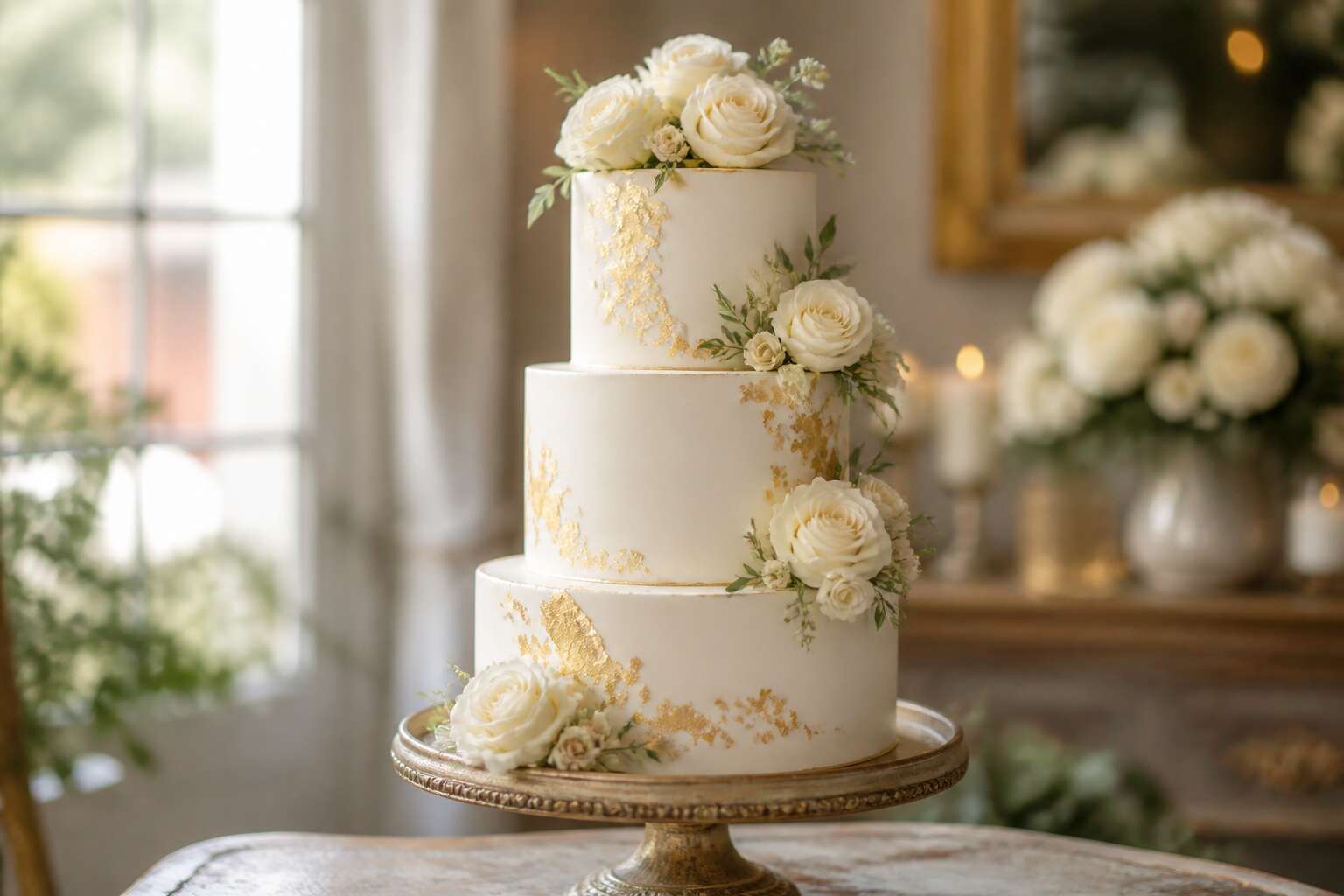
When the final layer of icing is smoothed over a wedding cake, it does more than create a pretty surface. The wedding cake symbolizes the couple’s commitment to refinement, a promise that patience and care can transform even the most uneven edges into something flawless. Icing acts as the great equalizer. It hides the seams between tiers, much like a marriage smooths over the small frictions of daily life.
This tradition gained momentum in the 19th century, when refined white frosting required significant skill and expensive sugar. A perfectly iced cake announced that the family could afford time, labor, and luxury. The pure white surface became shorthand for the ideal union: unblemished and orderly. For today’s couples, that symbolism remains, even when the flavor is chocolate or citrus. The act of icing is an act of devotion, applied layer by layer, with the same steady hand a relationship requires.
Tiers and Layers: Building a Shared Future
Every tier of a wedding cake symbolizes a distinct layer of the life a couple will build together. The bottom tier carries the weight of shared foundations; the top tier represents the private world the pair creates. Bakers still arrange tiers this way today, preserving that architectural meaning.
Ingredients add another code. Almond paste promises endurance, since marzipan preserves well. Warm spices represent domestic comfort, while brandy-soaked fruit references abundance that improves with age.
Some couples freeze the top tier for their first anniversary, turning symbolism into ritual. Specific shapes refine the message:
- Square tiers denote stability and equality
- Hexagonal forms suggest harmony and balance
- Scalloped edges mirror the rhythm of daily life
Wedding cake symbolizes the unique structure of a relationship.
Ornaments and Toppers: Unity, Love, and Protection
A cake topper is not mere decoration. It is the couple’s tiny ambassador, frozen mid-kiss on the highest tier. In Victorian England, brides placed a horseshoe on the cake for luck, and the custom survives. Modern toppers range from porcelain couples to whimsical animals, each choice a quiet code. Unity sits in the paired figures. Love appears in intertwined hands. Protection comes from the horseshoe or a sprig of rosemary tucked into the icing.
- A couple figurine stands for unity
- A horseshoe or key offers protection
- Doves or rings signal enduring love
Ingredients whisper their own promises. Honey, which never spoils, represents a marriage that outlasts time. Orange flower water, popular in South African weddings, suggests both purity and fertility. Lavender, added to the batter, wards off misfortune. The wedding cake symbolizes a shared fate, sealed with sugar and sealed with intent.
The Color White and Its Deeper Connotations
In optics, white contains every wavelength of visible light. The wedding cake symbolizes this hidden complexity on a South African table. White signifies total presence, not absence. It reflects light fully rather than absorbing it. A marriage that operates this way receives every experience and gives it back as shared memory. White icing represents an unmarked starting point.
Ingredients carry their own messages. Vanilla pods imply quiet luxury. Cardamom seeds suggest warmth entering the household. Ground cinnamon speaks to the sweetness of domestic routine. The wedding cake symbolizes these choices made permanent:
- Saffron threads, precious as gold, stand for prosperity that cannot be stolen
- Rose water, distilled from petals, preserves romance through difficult seasons
- Nutmeg, grated fresh, offers protection against bitterness
White design elements, from sugar lace to fondant drapes, echo the careful attention a marriage requires. Every piped dot is deliberate. Every smooth layer is intentional!
Cultural Variations of Wedding Cake Symbolism
British and Irish Traditions: The Christmas Cake Connection
In British and Irish households, the wedding cake symbolizes a bridge between life’s most significant rituals. The traditional rich fruit cake, steeped in brandy and wrapped in marzipan, was baked identically to the Christmas cake, creating a delicious symmetry between wedding and winter feasts. Families carefully preserved the top tier, not for mere sentiment, but for practical celebration:
- The christening of the first child
- The couple’s first Christmas together
- A golden anniversary, decades later
This saved slice became a talisman of continuity. When the cake reappeared at Christmas, its dense sweetness carried the memory of the vows with it. The wedding cake symbolizes endurance in these traditions, a promise that love’s sweetness can survive storage. It transforms a single wedding day into an ongoing thread of family life, one slice at a time.
Italian and French Confections: Elegance and Ritual
French elegance is physical. The croquembouche, a tall cone of caramel-glazed choux pastries, demands applause before a single bite! The wedding cake symbolizes ceremony itself, delicate choux stacked with precision. A hammer crack releases the structure, a shared act that turns dessert into theatre. This ritual, both playful and thoughtful, marks entry into marriage.
Italian ritual favours layers. Millefoglie, or thousand leaves, stacks crisp pastry with sweet cream. The wedding cake symbolizes the couple’s past, present and future. Almonds, hidden within, hold an old promise of abundance. Some regions serve torrone, a dense nougat that resists a quick bite. Guests chew slowly, a small ritual of patience. Elegance here is texture and weight.
African and Caribbean Interpretations: Community and Heritage
Across the Atlantic, the wedding cake symbolizes a different kind of architecture, one built on kinship rather than confectionery precision. In the Caribbean, the dense, dark rum cake takes center stage, a legacy of British fruitcake adapted to the islands. The alcohol does more than preserve; it infuses the celebration with a warmth that speaks to the long, slow fermentation of family bonds. Guests often receive a slice to take home, a tangible piece of the union that extends the feast beyond the venue.
African traditions offer a spectrum of meanings, where the communal act of baking becomes the ritual itself. The wedding cake symbolizes a shared responsibility, often prepared by a network of women from both families. This collective effort is the true ingredient.
– The cake’s rich, spiced crumb represents the blending of two lineages.
– Its size is a direct reflection of the couple’s social standing and generosity.
– The sharing of the first slice signifies the distribution of the couple’s fortune among their guests.
In this context, the cake is less about a singular aesthetic and more about the volume of goodwill it represents. It is a public declaration that the marriage is supported by a wide and sturdy network, an edible contract signed by the entire community.
Asian Wedding Cakes: Fusion and Modern Symbolism
The wedding cake symbolizes a visible negotiation between heritage and status across Asia. Chinese betrothal rituals once centered on pastry boxes filled with mooncakes and lotus seed paste. Today, couples in Shanghai and Singapore often display a Western tiered cake while keeping traditional flavors inside. In Japan, the first cut is often performed with a katana, a gesture that pairs sharp precision with joyful ceremony. This fusion is not decorative; it carries real weight. Each element encodes messages of prosperity and fertility for the new household.
- Whipped cream and strawberries, matching Japanese preference for light textures.
- Matcha layers, introducing a gentle, earthy counterpoint.
- Red bean fillings, a deliberate echo of older confectionery.
For South African couples of Asian descent, the wedding cake symbolizes a practical fusion that satisfies ancestral expectations and contemporary taste. Personally, I find this adaptable symbolism the most hopeful part of modern wedding design!
American Innovations: Grooms’ Cakes, Cupcakes, and More
Across the Atlantic, the wedding cake took a playful detour. The groom’s cake, often chocolate or red velvet, gives the groom his own spotlight, sometimes shaped like a football or fishing boat. It is a witty counterpoint to the bride’s pristine white tiers.
Cupcakes have replaced formal slices at many receptions. They offer portion control and flavor variety. A tower of cupcakes still delivers the ceremonial first cut, but without the anxiety of a collapsing tier.
- Groom’s cakes with humorous designs
- Cupcake towers with assorted flavors
- Donut walls and pie tables as alternatives
In this context, the wedding cake symbolizes flexibility. Americans treat tradition as a starting point, not a contract. The symbolism remains, but it bends to fit personality.
Rituals and Customs Around the Cake
The Couple’s First Cut as a Symbol of Partnership
Nearly every South African wedding includes a cake cutting, yet few pause to consider its meaning. The couple places their hands together on the knife, guiding the blade through the first slice. This wedding cake symbolizes a shared burden, the first task accomplished side by side as partners.
What follows matters just as much. Each partner lifts a piece to the other’s lips, a gesture of nourishment and trust. In several communities, the couple’s families receive the first wrapped portions, honouring the networks that sustain the marriage.
The ritual is simple, but its weight is profound. The wedding cake symbolizes a promise to feed one another emotionally and practically for the rest of life. A single cake, two hands, one shared path.
Feeding Each Other: Nurturing and Commitment
No two couples perform this ritual identically, yet the gravity of the moment remains a constant. When the bride lifts a morsel to the groom’s lips, she offers more than cake. She offers sustenance and a quiet vow to care for him in the lean years. The groom’s reciprocation mirrors this commitment, creating a loop of mutual support that the marriage will rely upon.
The act itself demands a specific vulnerability. You open your mouth to receive from your partner, trusting that they will not fumble or withhold. This exchange is a physical manifestation of faith. For many guests, this is the most emotionally charged part of the reception because it distills the entire marriage contract into a single, tender action.
In South African weddings, the feeding ritual often expands to include the couple’s parents. This inclusion acknowledges that the new household does not exist in isolation.
1. The couple feeds a piece to the bride’s mother and father.
2. They then feed a piece to the groom’s parents.
3. Finally, they share a piece with each other, sealing the circle of care.
This sequence reinforces the idea that the marriage is grafted onto existing roots. The wedding cake symbolizes the sweetness that the couple promises to cultivate, but the ritual reminds everyone that this cultivation requires a village. The shared bite is a contract of tenderness, a public demonstration that these two people will nourish each other through every season to come.
Preserving the Top Tier: Anniversary Memories
Some South African couples freeze the top tier of their wedding cake and share it on their first anniversary. The cake has lost its texture and flavor by then, yet the act remains meaningful. Eating that stale slice is a test of commitment. It proves you can accept the less perfect parts of marriage.
The wedding cake symbolizes a single day of celebration. Preserving the top tier redirects that symbolism toward continuity. You store a piece of the wedding for a future encounter with your own history.
- It forces a pause in the busy rhythm of new marriage.
- It asks you to taste what you promised.
- It makes the first year tangible.
Sharing With Guests: Spreading Blessings and Community
In many South African weddings, the cake sharing ritual is a silent language of welcome. The wedding cake symbolizes the couple’s unique story, but sharing it with guests turns that story into a collective narrative. Each crumb becomes a small blessing, a tangible wish for the union’s endurance. The community does not just watch; it partakes.
Common customs include:
- Keeping a slice for someone who could not attend, so they remain spiritually present.
- Distributing cake at the door as guests leave, extending the celebration outward.
- Offering the first shared piece to the eldest family member, a sign of respect.
These practices vary, but the core remains: giving away sweetness cements the couple’s place within their social world. The shared cake is a promise that no one celebrates alone.
Throwing the Garter and Its Ties to the Cake
The garter toss shares a lineage with the wedding cake. In older times, guests tore at the bride’s dress for luck, just as they reached for crumbs of the broken confection. The wedding cake symbolizes abundance distributed outward, and the garter carries that same charge.
When the bride tosses the garter, the unmarried guests assemble below. The cake is cut and shared; the garter is thrown and caught. Both actions release good fortune from the couple to the crowd. Some traditions place the garter inside the cake itself, so the finding and the tossing become one gesture. The bride’s lift of the skirt, the careful retrieval from the layers, the throw into waiting hands. Each moment returns something to the community that gathered to witness the union.
Modern Symbolism and Personalization in Wedding Cakes
Naked Cakes and the Beauty of Vulnerability
Industry research shows that nearly half of South African couples now request personalized cake elements over traditional ornamentation. The modern wedding cake symbolizes a shared aesthetic rather than inherited convention. Couples choose flavours, colours, and textures that reflect their actual relationship.
Naked cakes typify this movement. With minimal frosting, the exposed sponge and filling sit visible to every guest. I find that honesty compelling. The wedding cake symbolizes a couple’s willingness to show imperfection, and guests respond to that candour!
Personalisation extends beyond decoration. Couples incorporate handwritten notes between layers, savoury tiers for late-night grazing, and local ingredients like rooibos and amarula.
These choices turn each cake into a specific statement, one that admits its own roughness.
Alternative Desserts: Donuts, Cheesecakes, and Macarons
Today, the wedding cake symbolizes a couple’s lived experience, not a catalog template. I see brides choosing a milk tart infusion or a chilli chocolate layer that says something about their Sundays in Cape Town.
Some couples skip the cake altogether for a tower of glazed donuts or a cheesecake bar. Macarons add color. These alternatives still carry meaning:
- Donuts create a casual, shareable moment.
- Cheesecakes allow for bold flavor pairings.
- Macarons offer delicate precision.
Each option gives guests a taste of the couple’s actual preferences. That is a different expression of commitment.
Color Psychology in Cake Design and Meaning
Today, the wedding cake symbolizes a couple’s private narrative, not a template from a planner’s folder. Flavors carry the story. A rooibos infused layer honors slower Sunday afternoons. A salted caramel core hints at shared amusement at imperfection. Guests read these cues while eating, and that resonance outweighs tradition.
Color psychology shapes this choice. Couples select hues for the emotional response they create.
- Terracotta suggests warmth and grounded connection.
- Matcha green evokes growth and calm.
- Cobalt blue signals stability and depth.
These colors change the room before guests take a bite. In South Africa, this palette draws on place: the burnt orange of the Karoo, the pale green of a vineyard, the deep blue of the Atlantic. A lemon yellow base lifts a winter venue. A charcoal exterior with a gold interior rewards the curious. I find this honesty moving! The cake becomes an artifact of identity, and that is the new symbolism.
Custom Toppers and Sentimental Family Heirlooms
In modern South Africa, the wedding cake symbolizes a couple’s private world. Custom toppers now depict beloved pets, hiking boots, or a shared love of birdwatching. These small figures replace the generic bride and groom with objects that carry real memory. I have seen a topper shaped like a vintage kombi because that was where they first spoke for hours. The cake displays these memories in sugar.
Sentimental family heirlooms add another layer. Some couples place a grandmother’s brooch on the ribbon, or bake with the same mixing bowl that served three generations. Others display a fragment of a parent’s wedding veil beside the cake. These objects connect the present to a longer line of love. The wedding cake symbolizes continuity, a direct link from ancestors to what comes next, while still leaving room for play. That is the new ritual: honest, local, and deeply personal.
Eco-Friendly and Ethical Cake Choices
The wedding cake symbolizes more than a shared sweet tooth these days; it has become a canvas for ethics. Couples are scrutinizing the origins of their confection with the same intensity they apply to their wine list. The demand for local, organic, and fairly traded components is reshaping bakery supply chains. A cake made with free-range eggs and locally churned butter carries a different weight, both physically and metaphorically. This is a conscious move away from mass production toward a dessert that reflects a considered worldview.
This shift toward sustainability often pairs with a desire for personalization that feels authentic rather than manufactured. The wedding cake symbolizes a couple’s commitment to their principles, and the design follows suit. Bakers are now using natural food dyes derived from beetroot or turmeric instead of synthetic gels. Seasonal fruit from Western Cape orchards or nuts from the Klein Karoo might replace out-of-season imports. These choices create a narrative that is rooted in place and time, a true reflection of the here and now.
For couples planning their menu, the practical considerations are straightforward:
– Ask about the bakery’s waste management and composting policies.
– Check if the packaging for any leftover slices is recyclable or biodegradable.
– Inquire about the use of palm oil or other controversial ingredients.
– Consider a cake that uses less icing, which naturally reduces sugar and artificial colorants.
This focus on ethical sourcing does not diminish the romance; it enhances it. A couple who hikes Table Mountain every weekend might choose a cake adorned with indigenous fynbos. A pair of marine biologists could request a subtle wave pattern piped in sustainable blue spirulina. These details are not just decorative. They tell a specific story, and the wedding cake symbolizes that shared narrative. It becomes a testament to how they move through the world, not just on their wedding day, but every day. The result is a dessert that is both beautiful and principled, a fitting centerpiece for a modern union.
Themed Cakes That Tell Personal Love Stories
Some couples choose a cake that works like a timeline. A groom from Durban might request a buttercream wave crashing over a milk chocolate shoreline, referencing the beach where he proposed. This wedding cake symbolizes the moment their story took a new direction. The design becomes a visual biography, not a generic ornament.
Bakers across South Africa are embracing this storytelling approach. They sculpt, pipe, and layer edible scenes that reflect shared hobbies, travel memories, or inside jokes. Consider the practical details when planning yours:
- Bring reference photos of meaningful places, objects, or moments.
- Decide whether the theme should span all tiers or live on a single side.
- Ask the baker to sketch the design before you commit.
A themed cake feels personal when the details ring true. This wedding cake symbolizes a partnership with its own language. When guests recognize the subtle nod, they share in the memory. That recognition turns dessert into conversation.

0 Comments